How to Split Bills When Everyone Earns Different Amounts
An even split is fair when everyone is roughly in the same financial position. When they are not, it quietly forces the lowest earner to either overspend or opt out, and opting out is the part that damages the friendship.
Why an even split stops working
A NT$3,000 dinner split four ways is NT$750 each. For someone earning NT$120,000 a month that is a rounding error. For someone earning NT$38,000 it is a meaningful share of what they have left after rent.
The visible symptom is not complaint. It is the friend who is suddenly busy every time the group picks a restaurant, or who orders a starter and says they ate earlier. Uneven incomes do not usually produce arguments about money; they produce people quietly dropping out of the group.
Method 1: Split by income
Each person pays in proportion to what they earn. The arithmetic is one division and one multiplication.
Three flatmates share NT$36,000 of rent and bills. They earn NT$45,000, NT$60,000 and NT$75,000, NT$180,000 combined. Their shares are 25%, 33.3% and 41.7%, so they pay NT$9,000, NT$12,000 and NT$15,000.
| Earns | Share of income | Pays | Even split would be |
|---|---|---|---|
| NT$45,000 | 25.0% | NT$9,000 | NT$12,000 |
| NT$60,000 | 33.3% | NT$12,000 | NT$12,000 |
| NT$75,000 | 41.7% | NT$15,000 | NT$12,000 |
Straightforward, and it has an obvious flaw: it ignores everything else about someone’s situation. The highest earner here might be repaying a student loan the others do not have.
Method 2: Split by disposable income
Same maths, but each person first subtracts their genuinely fixed obligations, loan repayments, family support, medical costs. What remains is what they can actually choose how to spend, and the split runs on that.
Two friends both earn NT$70,000. One sends NT$20,000 a month to their parents. On income they look identical; on disposable income it is NT$50,000 against NT$70,000, a 42/58 split rather than 50/50.
The catch: this requires people to disclose more than a salary figure, and it invites arguments about what counts as fixed. A car loan is fixed. Is a car loan on a car nobody needed? Use this method only with people you would tell that anyway.
Method 3: Split the base, not the extras
The one that works best for friend groups, because it never requires anyone to say a number out loud.
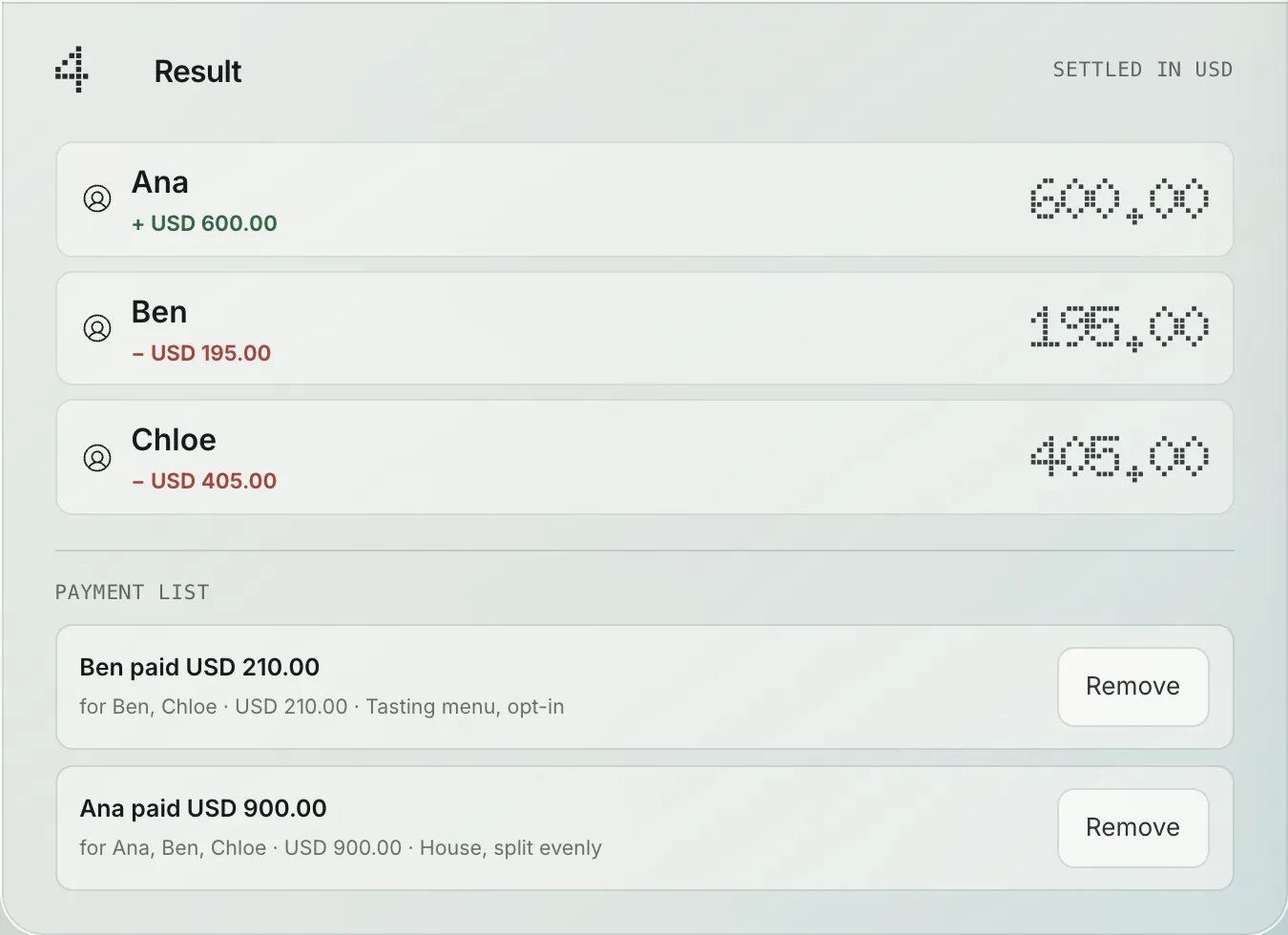
Shared costs everyone benefits from equally get split evenly: the taxi, the Airbnb, the rental car. Anything discretionary is charged to whoever chose it, the wine, the upgraded room, the tasting menu, the tour nobody else wanted.
This sidesteps income entirely and lands in roughly the right place anyway, because people self-select into the spending they can afford. It also removes the specific resentment that does the most damage: a light drinker subsidising a heavy one.
Practically, it means logging one dinner as two or three entries rather than one. The calculator is built for exactly this. Each payment has a “pay for” selector, so the NT$1,200 of wine is charged to the three people who drank it while the food stays shared.
Method 4: The quiet subsidy
Sometimes the honest answer is that one person covers more and nobody announces it. The higher earner books the accommodation and calls it their contribution; the group splits food evenly.
This works between close friends and fails between acquaintances, where it creates a debt the recipient never agreed to. If you are going to do it, do it without keeping a mental ledger, because a subsidy you are counting is not a gift, it is an invoice you have not sent yet.
How to raise it without making it strange
The conversation goes badly when it happens at the table with the bill already there. It goes fine when it happens in the group chat a week before, framed as logistics rather than anyone’s finances:
- “Shall we split the house evenly and everyone covers their own activities? Easier than tracking.”
- “Let’s set a rough per-day budget so we’re all picking places in the same range.”
- “I’m watching money this trip, so count me out of the fancy dinner, I’ll find something nearby and meet you after.”
Each of these is a statement about structure, not about anyone’s salary. That is the whole trick. Setting the expectation early is worth more than any formula, and it is why the norm-setting matters more than the arithmetic.
A note on couples and households
Everything above is about groups. Two people sharing a life have a different problem, because the money is not just being divided, it is being pooled over years. Proportional splitting is common there and works well, but the harder question is usually not the ratio. It is whether one person’s unpaid work, like childcare, is being counted at all. That is outside what a calculator can help with.
Nothing here is personalised financial advice. If money is causing real strain in a household, a licensed financial counsellor in your country will be more use than a splitting formula.
Related reading
- How to split group expenses fairly : even, proportional and itemized splits compared.
- Roommate shared expenses: 5 hidden costs : the household costs that cause the most friction.
Worked example
The structure this article argues for, entered as two lines: the house split evenly across everyone, and the expensive dinner charged only to the two who went.